
FINAL COMMUNIQUÉ
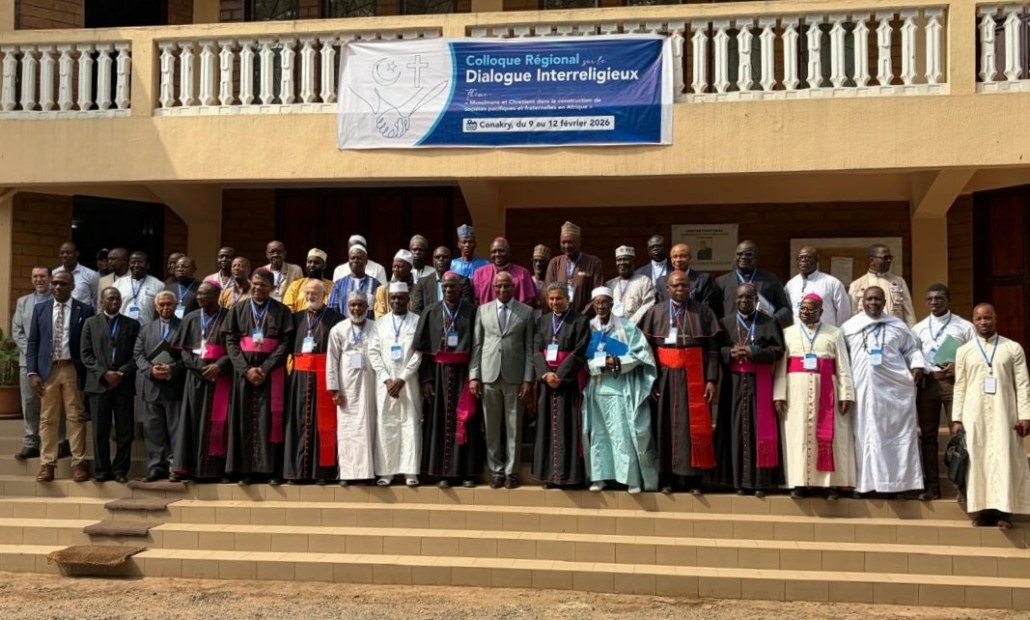
Regional Colloquium on Interreligious Dialogue
FINAL COMMUNIQUÉ
Regional Colloquium on Interreligious Dialogue
The Regional Colloquium on Interreligious Dialogue, entitled “Muslims and Christians in the Building of Peaceful and Fraternal Societies in Africa and Madagascar,” was jointly organized by the Episcopal Conference of Guinea and the Vatican Dicastery for Interreligious Dialogue within the framework of the launch of the Jubilee Year marking the 150th anniversary of evangelization in Guinea. It was held in Conakry (Republic of Guinea) from Monday, 9 February to Wednesday, 11 February 2026, at the Mgr. Raymond-Marie Tchidimbo Multipurpose Hall of the Archdiocese of Conakry.
The meeting brought together more than sixty Muslim and Christian religious leaders, Bishops responsible for Commissions for Interreligious Dialogue in Francophone West and Central Africa (Senegal, Mali, Burkina Faso, Benin, Cameroon, Congo, Central African Republic, Chad, Niger, Madagascar, Gabon, Guinea and Morocco), the Secretary and an Official of the Dicastery for Interreligious Dialogue, the Apostolic Nuncio to Guinea and Mali, Government and civil Authorities of the Republic of Guinea, academics, as well as representatives of civil society.
- Context
This Colloquium forms part of regional and international efforts aimed at promoting lasting peace, social cohesion, and human fraternity in Africa and beyond. It was convened within a context marked by persistent challenges, including armed conflicts, religious radicalization, identity-based tensions, the globalization of indifference, the instrumentalisation of religion and ethnic identity for personal or institutional gain, forced migration, African diasporas, as well as humanitarian and ecological crises.
The participants reaffirmed that Muslim-Christian dialogue and religious diplomacy constitute essential instruments for the prevention and management of conflicts, particularly in the face of religious radicalization, thereby fostering dialogue, mediation, social cohesion, and the consolidation of peaceful coexistence. They further emphasized the need for strengthened cooperation between religious leaders and governmental and civil authorities, in full respect of their respective competencies and shared responsibilities.
- Principle Findings
The proceedings of the Colloquium led to the following principal findings:
- In several countries and communities, the culture of encounter, living together, and peaceful and respectful interreligious coexistence remains deeply valued and carefully preserved. Bonds of kinship and community life continue to play a significant role.
- Conflicts and forms of religiously motivated radicalization are concentrated primarily in certain regions of Africa, notably the Sahel-Saharan belt (Mali, Burkina Faso, Niger, Chad, northern Nigeria), marked by the presence of extremist groups and conflicts combining insecurity, fragile governance, and intercommunal tensions; the Lake Chad Basin, where violence by extremist groups intertwines religious radicalization with poverty and historical marginalization; as well as certain areas of East and Central Africa (Eastern Democratic Republic of the Congo, Central African Republic, northern Mozambique), where armed conflicts include a religious dimension often intertwined with economic and identity-related factors.
- Often, these situations stem less from strictly religious conflicts than from complex dynamics involving political, socio-economic, and security-related factors, with religion frequently serving as a vector of mobilization.
- Mutual ignorance, prejudice, and exclusivist interpretations of sacred texts constitute significant factors of intercommunal tension.
- Christianity and Islam possess substantial spiritual, moral, and cultural resources, lived and embodied by their faithful, which can contribute decisively and sincerely to the promotion of peace, justice, and fraternity. To these may be added traditional African practices such as the palaver tree, joking kinship relations, and the philosophical framework of Ubuntu[1]. These traditions constitute endogenous instruments for the prevention and management of intercommunal conflicts.
- Effective interreligious dialogue is grounded in formation, mutual knowledge, mutual respect, and rootedness in local realities.
- The State plays a central role in guaranteeing freedom of religion and freedom of conscience, in promoting equality among citizens, and in establishing inclusive frameworks for dialogue.
- The credibility and effectiveness of interreligious dialogue depend upon the commitment of legitimate institutions and the implementation of inclusive public policies.
- Common convictions
The participants affirm that:
- Human fraternity constitutes a common ethical horizon that fosters peaceful coexistence.
- Religions are invited to contribute to conflict prevention and management, mediation, and social cohesion; they must not become sources of division. They should never serve as a pretext for domination, coercion, the imposition of truth, or underlying political agendas.
- Authentic Muslim-Christian dialogue is grounded in mutual respect, knowledge of the “other” and of his or her religion, attentive listening, recognition of human dignity, and respect for freedom of conscience.
- Religious diplomacy constitutes an essential instrument for the prevention and management of conflicts, particularly in the face of religious radicalization, by promoting dialogue, mediation, and the rebuilding of the social fabric and peaceful coexistence.
- Lasting peace is inseparable from social justice, good governance, and respect for human rights.
- Young people, women, and representatives of civil society are essential partners in interreligious dialogue, in processes aimed at sustainable peace, and in the promotion of universal human fraternity.
- Recommandations
The participants recommend:
- Recalling that, even when certain nations may presently appear spared from the most visible manifestations of religious radicalism, violent extremism, and armed conflict, peace is never a definitive achievement but a fragile reality requiring constant discernment and sustained commitment.
- Emphasizing, in light of the spiritual richness of Islam and Christianity highlighted during the proceedings of this Colloquium, the ethical and spiritual responsibility of religious and civil leaders, as well as the urgency of ongoing formation—particularly for religious leaders, young people, and women—in order to prevent any instrumentalisation of religion, notably through the integration of education for interreligious dialogue, peace, and responsible citizenship within religious and academic formation systems.
- Strengthening national and regional frameworks for interreligious dialogue through sustainable institutional mechanisms and inclusive interreligious platforms.
- Developing structured collaboration between religious institutions and public authorities for the prevention and management of religious radicalism and violent extremism, as well as for combating hate speech.
- Promoting a transition from a model of secularism understood solely as separation between State and Religion to a participatory secularism conducive to constructive engagement.
- Fostering a contextual approach to interreligious dialogue, respectful of local realities and of the autonomy of religious institutions.
- Implementing joint Muslim-Christian initiatives in favour of peace, integral human development, and solidarity, drawing inspiration from the Document on Human Fraternity for World Peace and Living Together (Abu Dhabi, 4 February 2019), and promoting its wider dissemination so that it may be known more broadly.
- Calling upon international organizations to avoid complicity in certain forms of injustice affecting Africa and Madagascar, and urging foreign countries to refrain from any direct or indirect involvement liable to divide African peoples or to undermine the legitimate interests and sovereignty of African nations.
- Ensuring greater involvement of young people and women in processes of dialogue and the pacification of African societies.
- Establishing mechanisms for follow-up and evaluation in order to ensure the effective implementation of the present recommendations.
- Prospects
The participants express the desire that this Colloquium will make a lasting contribution to strengthening of interreligious dialogue in Africa and Madagascar and serve as a reference point for similar initiatives in other regions. They reaffirm their commitment to work together for a peaceful, fraternal, and solidary Africa, founded on respect for human dignity, justice, and peaceful coexistence.
Acknowledgements
The participants express their gratitude to the Episcopal Conference of Guinea, the Dicastery for Interreligious Dialogue, the Apostolic Nunciature in Guinea and Mali, the Government of the Republic of Guinea, the Muslim and Christian religious authorities, as well as to all institutional partners who contributed to the organization of the Colloquium.
Conakry, 11 February 2026
Signatories
For the Dicastery for Interreligious Dialogue
Reverend Mgr Indunil J. KODITHUWAKKU K.
Secretary of the Dicastery for Interreligious Dialogue
For the Episcopal Conference of Guinea
+ His Excellency Mgr Alexis Aly TAGBINO
Bishop of Kankan and President of the Episcopal Conference of Guinea
For Muslim Leaders
El Hadj Mohamed Mansour FADIGA
Vice-President of the High Islamic Council of Guinea
For the Episcopal Commissions for Interreligious Dialogue
His Eminence Dieudonné Card. NZAPALAINGA, CSSp.
Metropolitan Archbishop of Bangui and Representative of the Episcopal Commissions for Interreligious Dialogue
For the Government of the Republic of Guinea
His Excellency Mr Karamo DIAWARA
Minister Secretary General for Religious Affairs of Guinea
For the Apostolic Nunciature in Guinea and Mali
His Excellency Mgr Jean-Sylvain Emien MAMBE
Apostolic Nuncio to Guinea and Mali
For the Archdiocese of Conakry
+ His Excellency Mgr Vincent COULIBALY
Metropolitan Archbishop of Conakry and representative of the Episcopal Conference of Guinea for the Colloquium
[1] Ubuntu is an African philosophy, particularly widespread in southern Africa, which asserts that human identity and dignity are built through relationships with others. It is often summarised by the expression: ‘I am because we are’.

